


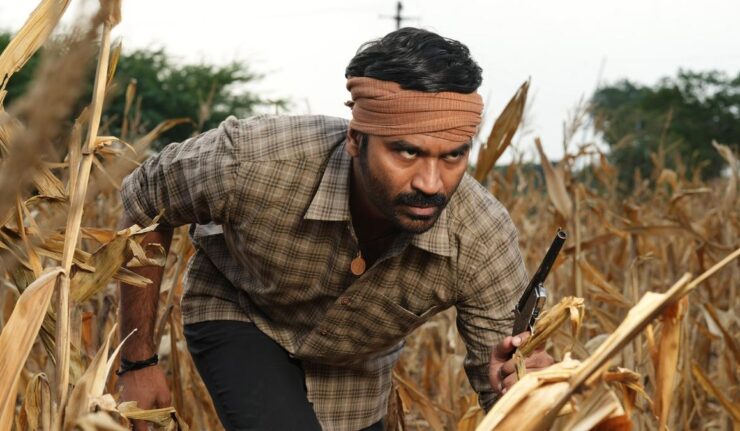
There was a time in Tamil cinema, not long back, where everything eventually got connected to agriculture (vevasayam), and our hero will always be that savior of farmers. Vignesh Raja, who made an impressive debut with Por Thozhil, is actually trying to go back to this forgotten trope. But the interesting thing here is that he is approaching it as a heist film. The second half of the movie is where we really see the thrilling elements of this story, and in totality, the sentimental quotient is on the higher side. Because of that, the grounded customized justice angle of the movie couldn’t really create that aura it aspires to have.
Karasaami, aka Kara, who was once caught for theft, escaped from custody and went to Andhra. He had to return to his homeland after some time, as he was badly in need of money. But when he returned, he realized that all the assets he thought his father had were already pledged to the bank. What all happens in his life when he tries to solve this financial mess is what we see in Kara.
Almost the entire first half is dedicated to showing the equation between Kara, his father, and their ancestral land, where they did agriculture. When you see the kind of risk the hero takes in the latter part of the movie, we will understand the need for this track in the story. However, the issue lies with the design of that part, where the melodrama isn’t landing effectively. Where the thrill kicks in is when we go to the complicated game inside the system. The revenge story of Kara makes way for a larger game, and one could sense the movie trying to break the predictability. But this shift in trajectory doesn’t last that long. The movie somewhat rushes to the large-scale justice angle to get closure.
Written by Alfred Prakash along with Vignesh Raja, the movie’s weakness lies in the screenplay that is not able to balance thrills and sentiments evenly. In the initial parts of the movie, Vignesh is using visual storytelling very effectively. There are a couple of instances where the shadows created by lightning are used to depict the scale of the moment. The rain sequence in the beginning was used to show the emotional state of the hero. In the final conversation, the alignment of the tractor had a purpose. The staging of some of the tense moments in the film, like the one featuring Aadukalam Naren or the one where the police were about to capture the robbers, had an engaging rhythm. However, for some reason, the movie decides to go with an on-your-face tone in several other areas. And that felt like a mistrust towards the audience. The music from GV Prakash was fine. The action blocks are pretty minimal in terms of duration.
Karasaami is not necessarily a heroic character, and Vignesh establishes that in the opening sequence itself. The desperation and angst of that character were performed neatly by Dhanush. KS Ravikumar was impressive as the father character of Kara. Karunas gets an extensive role in the movie as Kasi, and he was pretty good. Mamitha Baiju’s character’s duration in the film is relatively minimal. However, I must say she has grabbed this as an opportunity to show that she can play the part of a rural Tamil girl if needed. Sreeja Ravi played the part of Kara’s mother. Suraj Venjaramood gets an interesting character in the movie, and even though at times his dialogue delivery had that Malayalam dialect, he makes up for it through effective body language and voice modulation. Jayaram also plays a crucial role that started interestingly and faded off generically.
The fact that this movie is set in the early ’90s during the Kuwait war allows it to place the heist idea believably. The lack of technological advancement, such as the absence of mobile phones and CCTV cameras, is making it easy for the writing. But instead of exploring the possibilities of an enticing cat-and-mouse game between the police and the thief, Vignesh Raja’s Kara gets stuck in the reasoning part for a bit too long. On the whole, Kara felt like an impressive idea that got diluted by excessive emotions to please a larger audience.
RATINGS : 4/5
PRO : AIM SATHISH